The job market in 2026 rewards clarity. Sending more applications can feel productive, but it often creates more silence if every application looks the same. The job seekers who get traction are usually not the ones applying everywhere. They are the ones who can quickly show why they fit a specific role, what evidence supports that fit, and what gaps they are actively closing.
That is especially true for students, graduates, and career changers. If you do not have a long employment history, your advantage is not volume. It is focus, relevance, and a smarter way of proving potential.
Below are job hunting tips that actually work in 2026, based on how hiring teams, applicant tracking systems, AI tools, and competitive candidate pools now operate.
What has changed about job hunting in 2026?
The core goal has not changed: employers still want capable people who can solve real problems. What has changed is how quickly they need to identify those people.
Hiring teams are dealing with larger applicant pools, more AI-generated applications, and tighter screening processes. Many recruiters use applicant tracking systems to organise applications and search for relevant skills. Hiring managers may only spend a short time scanning a resume before deciding whether it deserves deeper attention.
At the same time, applicants have more tools than ever. AI can help draft resumes, rewrite cover letters, and prepare interview answers. But because everyone has access to similar tools, generic AI-written content is easier to spot. A polished application is no longer enough. It needs to be specific, credible, and clearly aligned to the role.
In 2026, a strong application answers three questions quickly:
- Can this person do the work?
- Have they shown evidence of similar skills, even in a different context?
- Do they understand what this role actually requires?
If your resume, cover letter, LinkedIn profile, and interview answers all support the same story, you are easier to trust.
Start with a narrower target role
One of the most useful job hunting tips is also one of the least glamorous: stop applying before you know exactly what you are aiming for.
A vague search creates vague applications. If your target is simply “marketing jobs”, “business roles”, “IT jobs”, or “anything entry level”, every application will need too much interpretation from the employer. A narrower target makes it easier to choose the right skills, examples, keywords, and achievements.
Before updating your resume, define:
- The role titles you are targeting
- The industries or company types you prefer
- The level you are genuinely ready for
- The location or work arrangement you need
- The five to eight requirements that appear most often in job ads
This does not mean you can only apply for one exact title. It means you are building a clear lane. For example, a commerce graduate might target assistant analyst, operations coordinator, and business support roles because they share similar evidence. A career changer from retail might target customer success, account support, or operations roles because their communication, problem-solving, and stakeholder skills transfer well.
Clarity saves time because every application can be judged against the same question: does this role match the story I am trying to prove?
Read job ads like assessment criteria
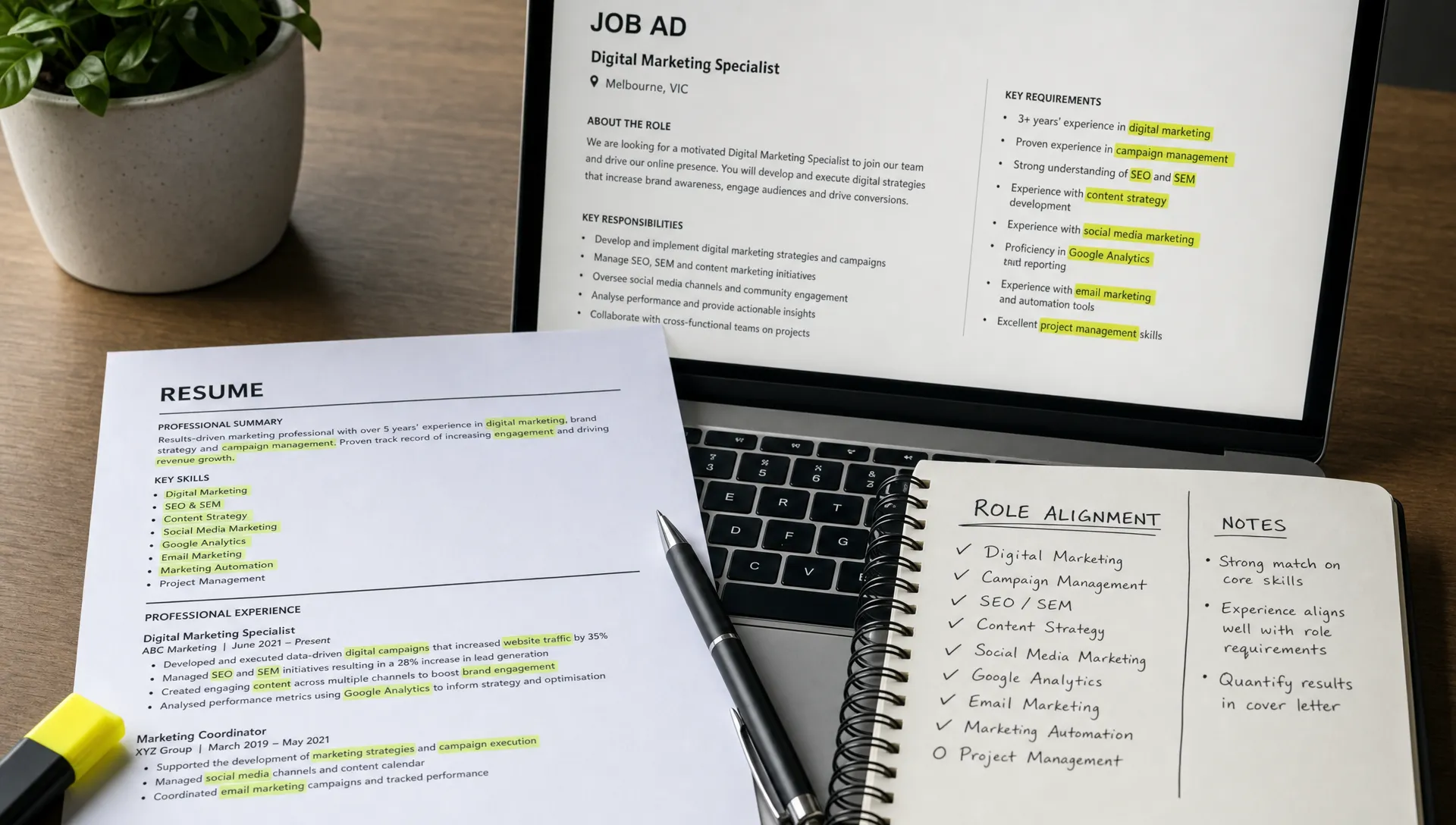
A job ad is not just a description. It is a scoring guide.
Most job seekers skim the role, check the salary or location, and then apply with a lightly edited resume. Stronger candidates look for the hidden structure. They identify what the employer will likely screen for and then build the application around that.
Look for patterns in:
- Repeated skills or tools
- Words such as “essential”, “required”, “demonstrated”, and “highly regarded”
- Outcomes the person will be responsible for
- Stakeholders they will work with
- Problems the role seems designed to solve
If a job ad repeatedly mentions stakeholder communication, reporting, and deadlines, your resume should not bury those examples under unrelated duties. If the ad focuses on customer support, accuracy, and CRM experience, your application should make those signals obvious.
This is where strategy matters more than guesswork. If you want a deeper process for turning job ads into stronger applications, Versadox has a useful guide on job hunting strategies for better application results.
Build an evidence bank before you tailor anything
Many applicants struggle because they try to write the perfect resume from memory. That usually leads to generic phrases like “strong communicator”, “team player”, or “fast learner”. These may be true, but they do not prove much.
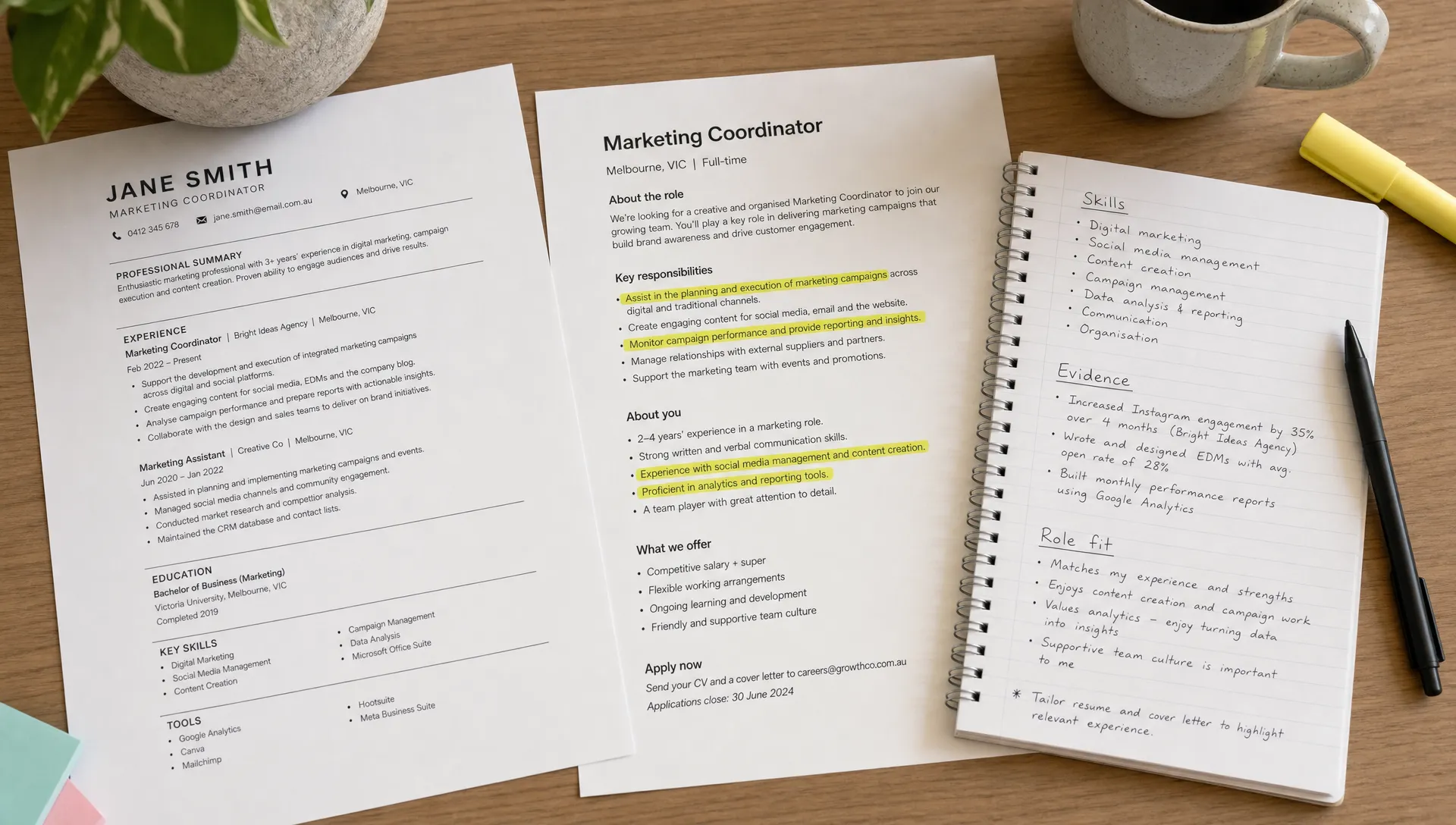
Instead, build an evidence bank. This is a simple document where you collect examples you can reuse across resumes, cover letters, interviews, and LinkedIn updates.
Include examples from work, study, volunteering, internships, personal projects, sport, community roles, or family responsibilities. Employers care about context, but they also care about behaviour. If you solved a problem, improved a process, helped a customer, organised something, analysed information, or learned a tool quickly, that may be useful evidence.
For each example, capture:
- The situation or problem
- The action you took
- The tools, skills, or knowledge you used
- The result, improvement, or lesson
- Any numbers, timeframes, or scale you can honestly include
For example, “helped customers” becomes stronger when it turns into “handled 40 to 60 customer enquiries per shift, resolved common payment issues, and escalated complex complaints to the manager with accurate notes”.
You do not need dramatic achievements. You need concrete proof.
Tailor your resume around role fit, not personality
Your resume is not a full autobiography. It is a case for why you fit this role.
That does not mean inventing experience or stuffing keywords. It means choosing the most relevant evidence and making it easy to find. A recruiter should not have to work hard to connect your background to the job ad.
In 2026, tailoring usually means adjusting:
- Your professional summary so it reflects the target role
- Your skills section so the most relevant skills appear first
- Your experience bullet points so they highlight matching evidence
- Your education, projects, or certifications when they help prove readiness
- Your section order so the strongest proof appears early
If you are changing careers, tailoring becomes even more important. You may need to translate previous experience into the language of the new role. Retail experience might become customer needs analysis, conflict resolution, stock coordination, team communication, and operational accuracy. University projects might become research, reporting, presentation, stakeholder management, or data interpretation.
For a more detailed walkthrough, read Versadox’s guide on how to match your resume to the job you want.
Optimise for ATS, but write for humans
Applicant tracking systems matter, but they are not the only audience. A resume that is packed with keywords but hard to read can still fail when a person opens it.
The best approach is simple: use the employer’s language where it is accurate, keep the formatting clean, and make your evidence easy to scan.
Avoid overly designed resumes with unusual columns, icons, graphics, or text boxes if they make the content harder to parse. Use clear section headings, consistent formatting, and role-specific language. Save creative design for portfolios or personal websites when relevant.
A strong ATS-friendly resume is not robotic. It is structured. It gives both software and humans the information they need without friction.
Use AI carefully, not lazily
AI can improve your job hunt if you use it as a thinking partner. It can help identify gaps, rewrite unclear bullet points, suggest interview questions, and compare your experience against a role description. But it should not replace your judgement or your voice.
The risk in 2026 is sameness. If your cover letter sounds like every other AI-generated cover letter, it may be polished but forgettable. Employers are looking for evidence, not generic enthusiasm.
Use AI to help with:
- Clarifying confusing resume bullet points
- Finding missing keywords from a job ad
- Creating interview practice questions
- Summarising your evidence bank by role type
- Checking whether your application answers the employer’s main requirements
Do not use AI to invent achievements, exaggerate experience, or produce a cover letter you have not personalised. The strongest applications combine AI efficiency with human judgement.
This shift is not limited to job seekers. Organisations are also adapting to how AI systems find, summarise, and recommend information. Tools such as CapstonAI show how seriously brands now take AI visibility, which is a useful reminder that discoverability and trust are becoming part of every professional landscape.
Make your cover letter solve a specific problem
Cover letters still matter when they add context your resume cannot. They are especially useful if you are a graduate, career changer, returning to work, applying for a role with selection criteria, or explaining why your background is relevant.
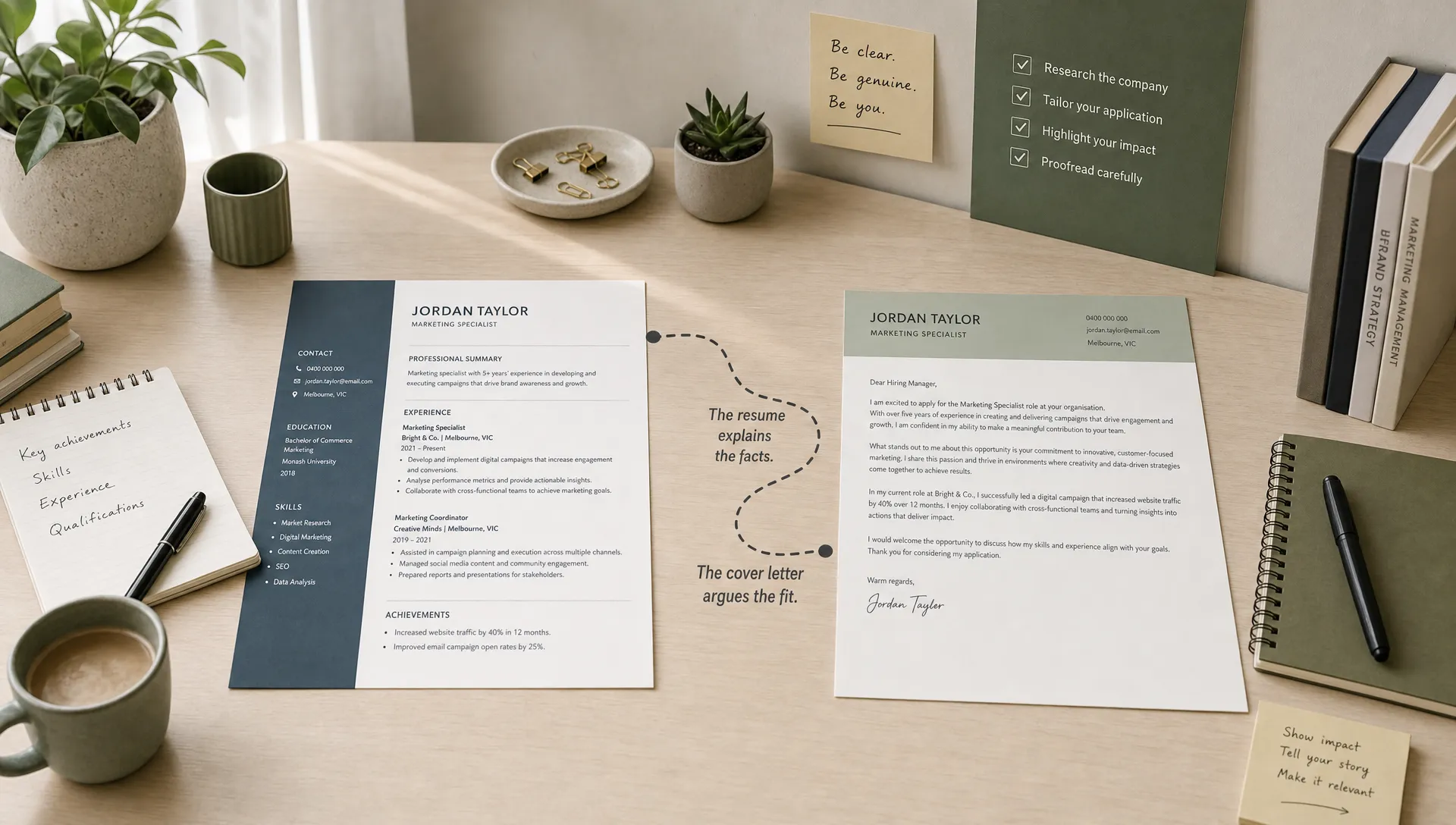
A weak cover letter repeats the resume. A strong one connects the dots.
Use your cover letter to explain why this role makes sense, which two or three requirements you match best, and what evidence supports that match. Keep it concise and specific. If the employer asks for a cover letter, treat it as part of the assessment, not a formality.
A practical structure is:
- Opening: name the role and state your fit clearly
- Middle: prove two or three key requirements with examples
- Closing: reinforce your interest and readiness for the next step
For more support, Versadox has a dedicated guide on writing cover letters that win more interviews.
Network with relevance, not desperation
Networking does not have to mean awkward events or asking strangers for jobs. In 2026, effective networking is often quiet, specific, and research-based.
The goal is to learn faster, become more visible, and build warm context around your applications. This is especially helpful for students and career changers who may not have a strong professional network yet.
Instead of sending “Can you help me get a job?” messages, ask better questions. For example, you could message someone in a role you are targeting and say you are researching the field, then ask what skills they use most often or what they wish they had known before starting.
Good networking habits include:
- Following companies you genuinely want to work for
- Commenting thoughtfully on industry posts
- Asking alumni or former colleagues for role insights
- Attending university, industry, or local career events
- Reconnecting with people before you need a favour
Networking works best when it is consistent. Ten thoughtful conversations over two months can teach you more than 100 silent applications.
Track your applications like a learning system
If you are not tracking your job hunt, you are guessing.
A basic spreadsheet or notes app is enough. Record the role, company, date applied, resume version, cover letter version, response, interview stage, and lessons learned. Over time, patterns will appear.
If you are getting no responses, your targeting, resume alignment, or experience proof may need work. If you are getting interviews but no offers, your interview preparation, examples, or role fit may need attention. If you are getting phone screens but not progressing, your salary expectations, communication, or availability may need review.
Tracking reduces emotion because it gives you data. It helps you separate a bad week from a broken strategy.
Prepare interview stories before you are invited
Many job seekers wait until they get an interview to prepare examples. That creates stress and rushed answers.
Instead, use your evidence bank to prepare stories early. Most interviews are testing the same themes: communication, problem-solving, teamwork, adaptability, initiative, attention to detail, and motivation.
Prepare examples that show:
- A time you solved a problem
- A time you handled pressure or deadlines
- A time you worked with difficult people or competing priorities
- A time you learned something quickly
- A time you made a mistake and improved from it
Use a simple structure: situation, task, action, result, and reflection. The reflection matters because employers want to see judgement, not just activity. What did you learn? What would you do again? What would you improve?
For graduates and career changers, interview preparation is also where you can turn non-traditional experience into strong evidence. Casual work, group assignments, volunteering, and personal projects can all become relevant if you explain them well.
Follow up without being annoying
A good follow-up is short, polite, and useful. It should not pressure the employer or sound entitled.
After an interview, send a brief thank-you message within 24 hours if you have the contact details. Mention something specific from the conversation and reinforce your interest. If you have not heard back after the timeframe they gave you, a short check-in is reasonable.
Follow-up will not rescue a weak application, but it can reinforce professionalism. It also helps you stand out in a process where many applicants disappear or communicate poorly.
Protect your energy and improve weekly
Job hunting can become emotionally draining, particularly when rejections are vague or employers do not reply. A smarter process helps, but it does not remove every disappointment.
Set a weekly rhythm you can sustain. For example, you might spend one session researching roles, one session tailoring applications, one session networking, and one session improving your resume or interview examples. This is better than panic-applying late at night whenever anxiety spikes.
Your goal is not to control every outcome. It is to improve the quality of your inputs and learn from the market.
A good weekly review asks:
- Did I apply for roles that genuinely fit my target?
- Did each application clearly prove the top requirements?
- Did I reuse evidence or default to generic claims?
- Did I make one networking or learning move?
- What pattern is showing up in my responses?
Small improvements compound. The application you send in week six should be sharper than the one you sent in week one.
Frequently Asked Questions
What are the best job hunting tips for 2026? The best tips are to target specific roles, tailor every resume, use evidence instead of generic claims, optimise for ATS readability, use AI carefully, network with relevance, and track your results so you can improve.
How many jobs should I apply for each week? Quality matters more than volume. A smaller number of well-targeted applications is usually stronger than dozens of generic submissions. If you can tailor each one properly, five to ten strong applications per week may be more effective than mass applying.
Should I use AI to write my resume? You can use AI to improve structure, clarity, and alignment, but you should not let it invent achievements or remove your voice. Always check that the final resume is accurate, specific, and relevant to the role.
Do cover letters still matter in 2026? Yes, when they add useful context. Cover letters are most valuable when they explain motivation, career changes, transferable skills, or specific evidence that supports your fit for the role.
Why am I not hearing back after applying? Common reasons include applying for roles that are not well matched, using a generic resume, missing key requirements, weak evidence, unclear formatting, or heavy competition. Track your applications to identify where the process is breaking down.
Apply with more clarity and confidence
The job hunting tips that work in 2026 all point to the same principle: prove fit before you apply. Do not make employers guess how your background connects to the role.
Versadox helps job seekers score their resume, LinkedIn profile, and fit for a specific role, then ranks the fixes that matter most before applying. If you are a student, graduate, or career changer, it can help you move from “I hope this is good enough” to a clearer, more confident application strategy.






.svg)