A slow market can make even strong candidates feel invisible. You apply, wait, refresh your inbox, then wonder whether the problem is your resume, your experience or the economy. Often, it is a mix of all three, but not in the way most job seekers think.
When hiring slows, employers usually become more selective. They may take longer to approve headcount, compare more applicants for the same role or pause a vacancy after interviews have already started. That does not mean you should stop applying. It means your job hunt needs to become more precise.
The smartest advice for job hunting in a slow market is simple: stop treating applications like lottery tickets. Treat them like targeted business cases. Your resume, cover letter and interview answers need to show why you fit this role, at this level, in this organisation, right now.
What changes in a slow job market?
In a fast market, employers often hire for potential because vacancies need to be filled quickly. In a slow market, they tend to reduce risk. They look for clearer evidence that a candidate can step in, learn fast and solve the exact problems attached to the role.
That shift affects students, graduates, career changers and experienced professionals in different ways. Graduates may see more competition for entry-level roles. Career changers may find employers less willing to infer transferable skills. Experienced applicants may be screened out if their resume looks too broad or too senior for the position.
The mistake is assuming the only answer is volume. Sending more applications can help if each application is well aligned. Sending more generic applications usually creates more silence.
A slow market rewards candidates who can control four things:
- The roles they target
- The evidence they present
- The speed and quality of their applications
- The consistency of their follow-up and networking
You cannot control every hiring freeze or recruiter response. You can control whether your application makes the recruiter’s decision easier.
Narrow your target before you widen your search
When jobs feel scarce, it is tempting to apply for anything that looks remotely suitable. This feels productive, but it often weakens your positioning. If your resume tries to suit marketing, administration, customer service, sales and operations at the same time, it may not look strong enough for any one of them.
Start by choosing two or three role families that genuinely match your current evidence. A role family is a cluster of jobs that use similar skills, even if the titles vary. For example, a graduate interested in business roles might target customer success associate, sales operations coordinator and account coordinator roles. A hospitality worker moving into office work might target reception, rostering, client support or operations assistant roles.
For each role family, write a short role thesis. This is a plain-English explanation of why you are credible for that path.
A useful role thesis might sound like this: “I am targeting client support and operations roles because I have handled high-volume customer issues, coordinated shifts, used booking systems and solved time-sensitive problems in busy service environments.”
That one sentence gives your search direction. It also makes your resume easier to tailor because you know which achievements to foreground.
Build applications around proof, not personality claims
In a slow market, adjectives are weak currency. “Hardworking”, “motivated” and “fast learner” can be true, but they do not separate you from other candidates. Proof does.
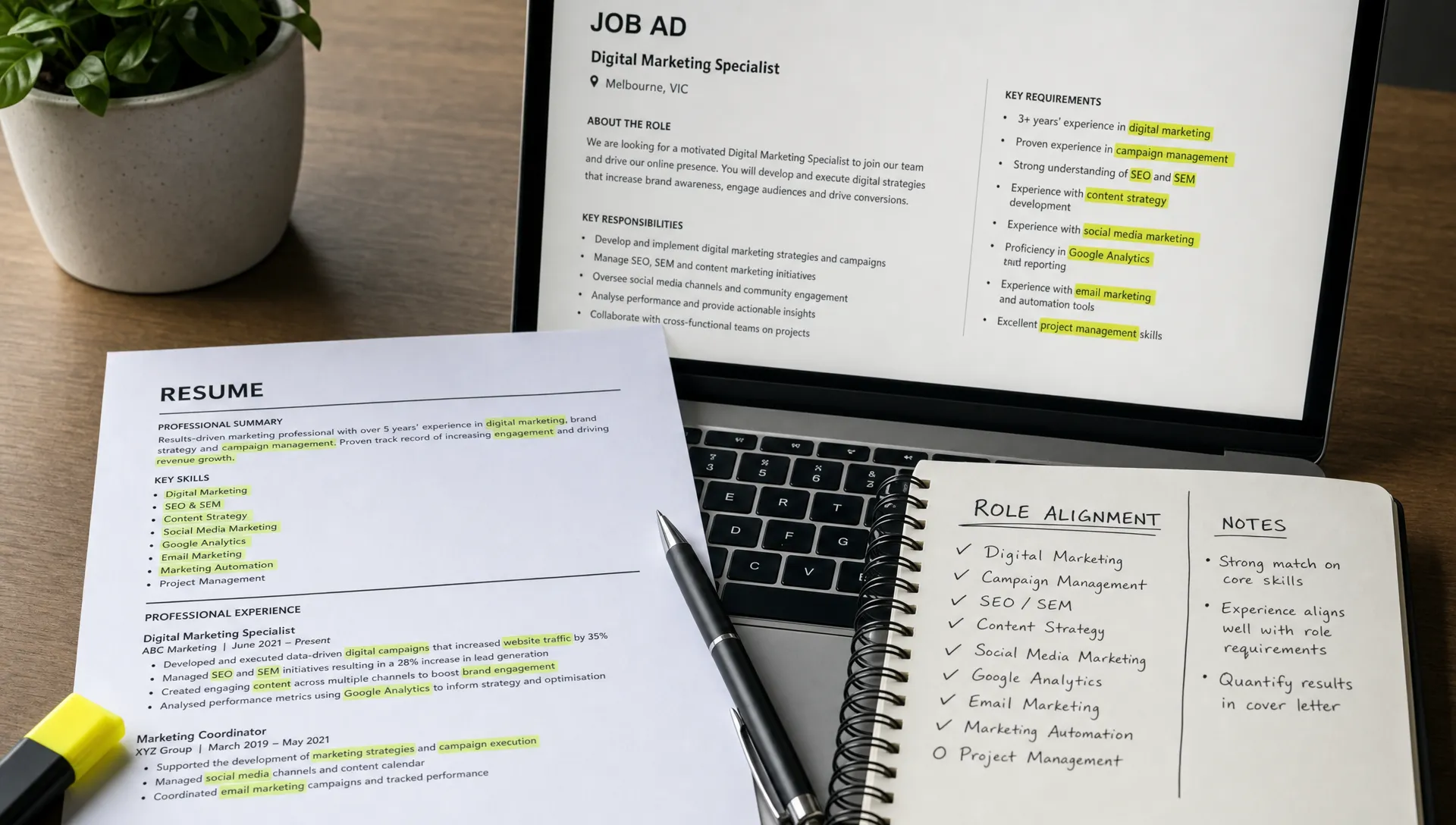
Read the job ad as if it is a scoring guide. Employers are telling you what they want to see: systems, customer types, communication demands, industry context, technical skills, compliance requirements or pace of work. Your task is to connect your experience to those signals.
If the job ad asks for stakeholder communication, do not simply list “communication skills”. Show the situation. For example: “Handled daily enquiries from customers, suppliers and internal staff, resolving booking changes and urgent issues under time pressure.”
If the job ad asks for data accuracy, show how accuracy appeared in your previous work. For example: “Maintained order records, reconciled delivery details and corrected discrepancies before end-of-day reporting.”
This is especially important for career changers. Recruiters may not automatically translate retail, hospitality, trades, volunteering or study projects into corporate language. You need to do that translation for them. If you want a practical walkthrough, Versadox has a guide on how to match your resume to the job you want without turning it into a keyword dump.
A strong application does not exaggerate. It makes relevant evidence easier to find.
Apply with a tiered strategy, not one default resume
Not every role deserves the same level of effort. In a slow market, you need enough volume to stay in motion, but enough selectivity to avoid wasting energy.
A simple tiered system can help:
- Tier 1 roles are strong-fit jobs where your experience, interests and location or work rights line up well. These deserve a tailored resume, tailored cover letter and thoughtful follow-up where appropriate.
- Tier 2 roles are reasonable-fit jobs where you meet many criteria but may have one or two gaps. These deserve a tailored resume and a short, focused cover letter if requested.
- Tier 3 roles are lower-probability applications. These can be useful for practice or market testing, but they should not consume most of your week.
This approach protects your best energy for the roles where it can actually change the outcome. It also reduces the emotional damage of treating every rejection as equally meaningful.
For Tier 1 roles, aim to apply early where possible. Many employers review applications as they arrive, especially when applicant volume is high. Early does not mean rushed. It means having your core materials prepared so you can customise quickly when a suitable job appears.
Stop reading every silence as personal rejection
Ghosting is frustrating, but it is not always a reflection of your potential. Some employers receive hundreds of applications. Some roles are paused. Some applicant tracking systems filter resumes before a person reviews them. Some recruiters only contact shortlisted candidates because they are managing multiple vacancies at once.
That does not make silence acceptable, but it does mean you should diagnose it carefully. If you are getting no responses after dozens of applications, the issue may be alignment, clarity or targeting. If you are getting interviews but no offers, the issue may be interview evidence, salary alignment or role fit. If you are reaching final stages, your strategy is probably closer than it feels.
Versadox has covered the mechanics behind this in more detail in its article on why job seekers are getting ghosted. The key point is that your job search is a system. Silence is data, not a verdict.
Fill visible gaps before employers use them against you
A slow market gives employers more room to compare candidates closely. If the same gap appears across multiple job ads, do not ignore it.
Common gaps include lack of industry exposure, limited software experience, weak examples of teamwork, no measurable achievements or unclear communication about career change. You do not need to fix every gap before applying, but you should address the ones that repeatedly block you.
Small proof assets can help. A student applying for marketing roles might create a short portfolio of campaign analysis, social content or email samples. A career changer moving into administration might complete a short course in Excel, then update their resume with specific spreadsheet tasks they can now perform. A graduate applying for analyst roles might build a simple project using public data and explain the process in interviews.
The goal is not to collect random certificates. The goal is to reduce doubt. If an employer might wonder, “Can this person do the work?”, give them something concrete to assess.
Use networking as research, not begging
Many job seekers avoid networking because it feels awkward. It becomes easier when you stop treating it as asking strangers for jobs. In a slow market, networking works best as a research habit.
Reach out to people who are one or two steps ahead of you, not only senior leaders. A recent graduate in the role you want may give more practical advice than a director who hired differently ten years ago. Ask about the skills they use most, the mistakes they made when applying and what they wish they had included on their resume.
A simple message can work:
“Hi Sam, I noticed you moved from retail into customer success last year. I am exploring a similar move and would appreciate one piece of advice on how you positioned your experience. No pressure if you are busy.”
That message is specific, respectful and easy to answer. It does not demand a referral. It opens a conversation.
If the conversation goes well, you can later ask whether they know what hiring managers in their team usually look for. Sometimes that insight is more valuable than a formal introduction.
Protect your energy like it affects your results, because it does
A slow market can stretch a job hunt from weeks into months. When that happens, your routines matter. Poor sleep, constant scrolling and irregular meals make it harder to write clearly, interview well and recover from rejection.
You do not need a perfect wellness routine. You need a repeatable one. Set application blocks instead of staying half-available all day. Keep a fixed time for exercise or walking. Avoid rewriting your resume late at night when you are more likely to overthink everything.
If the job hunt has disrupted your health habits, structured support such as personalised exercise and nutrition coaching can help you rebuild consistency while you manage applications, interviews and uncertainty.
This is not a side issue. Hiring processes require communication, judgement and confidence. Those are harder to access when you are exhausted.
Build a weekly job hunt operating rhythm
Motivation rises and falls, so do not rely on it. Create a weekly rhythm that keeps your search moving even when the market feels slow.
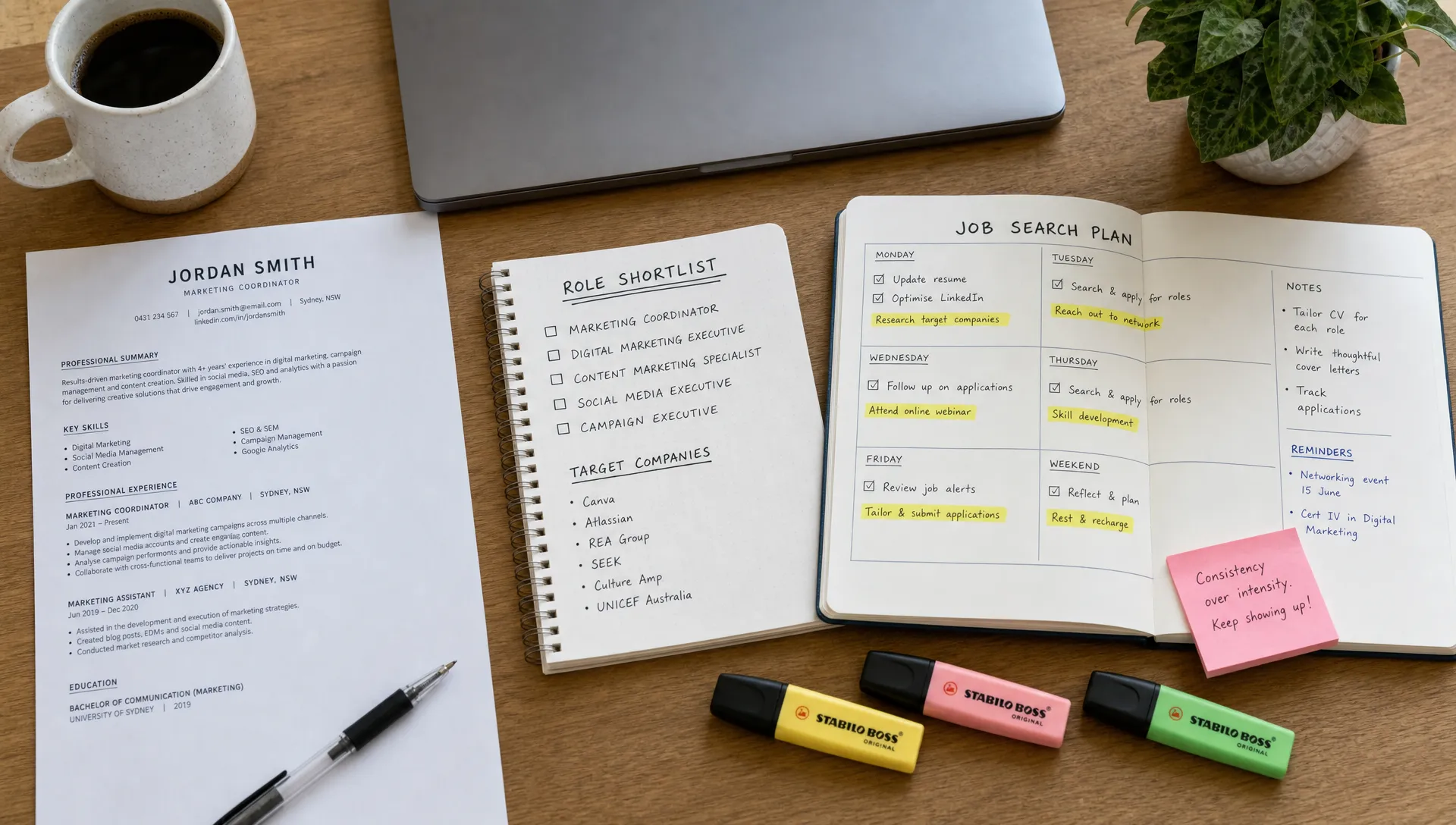
A balanced week might include:
- One session to review new roles and shortlist Tier 1 and Tier 2 opportunities
- Two or three focused application blocks for tailored resumes and cover letters
- One networking or research block to message people, attend events or learn about companies
- One improvement block to close a skill gap, refine interview stories or update your portfolio
- One review block to track responses, identify patterns and adjust your targets
This structure prevents the two extremes that hurt job seekers: panic applying and total avoidance. It also helps you see progress beyond offers. In a slow market, progress often appears first as clearer targeting, better interview answers, stronger recruiter responses and fewer wasted applications.
Follow up without sounding desperate
Following up will not rescue a poor-fit application, but it can help when your profile is relevant and the employer is still deciding. Keep it short, professional and useful.
After applying, you might follow up if you have a real contact, a referral pathway or a strong reason for interest. Do not send a generic “just checking in” message to every recruiter. Instead, add context.
For example: “I applied for the operations coordinator role this week and wanted to briefly highlight my experience managing daily scheduling changes across a team of 25. The role’s focus on coordination under time pressure is closely aligned with my background.”
After an interview, send a thank-you message that reinforces fit. Mention one topic discussed and connect it back to your evidence. This helps the interviewer remember you for the right reasons.
Measure the right signals
If you only measure offers, the job hunt will feel like failure until the final moment. Better metrics help you adjust earlier.
Track signals such as:
- How many applications are closely matched to your target role family
- Which resume versions generate callbacks
- Which job titles produce the best response rate
- Which interview questions keep catching you off guard
- Which gaps appear repeatedly in job ads or recruiter feedback
Patterns matter more than one-off outcomes. If graduate assistant roles produce responses but coordinator roles do not, your next step may be targeting level, not rewriting your whole resume. If interviews stall after salary discussions, your positioning may be fine but your expectations or role selection may need review.
A slow market punishes guesswork. Tracking turns the search into something you can improve.
How Versadox helps in a slow market
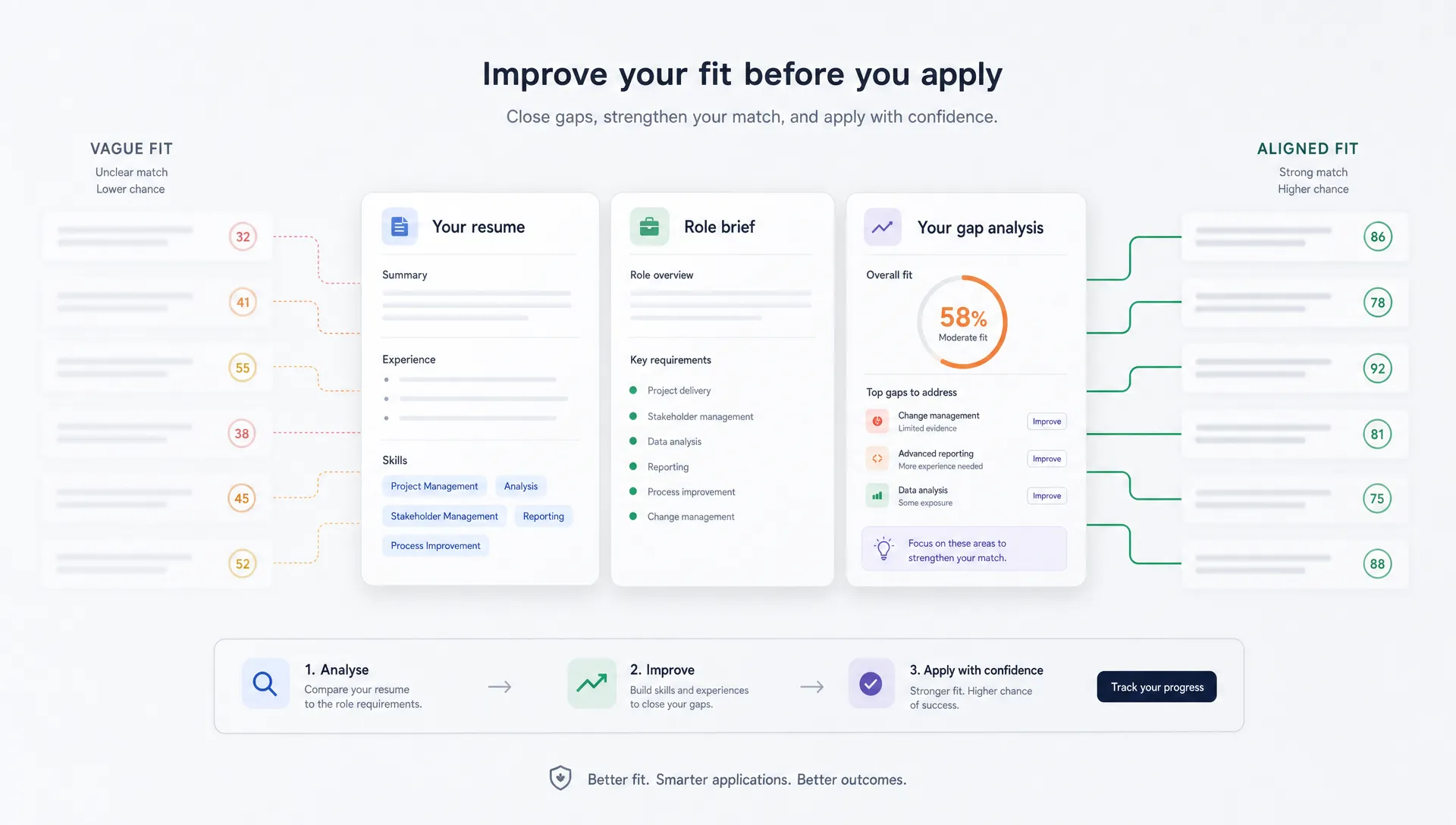
Versadox is built for job seekers who want to know where they stand before they apply. Instead of guessing whether your resume is strong enough, you can compare your application against real roles, identify gaps and make guided improvements.
That matters more when hiring is cautious. A slow market gives you fewer chances to waste on vague applications. Versadox helps you strengthen your resume and cover letter, assess role alignment, review readiness and export ATS-ready documents when you are ready to apply.
For students, graduates and career changers, this can create a clearer path from “I think I can do this job” to “Here is how my experience matches what this employer needs.”
Frequently Asked Questions
Should I apply for more jobs in a slow market? Apply consistently, but do not rely on volume alone. A smaller number of well-targeted applications will usually outperform a large number of generic ones. Use higher effort for roles where your evidence clearly matches the job ad.
How do I know if my resume is the problem? If you are applying for suitable roles and getting no responses across many applications, your resume may not be communicating fit clearly. Review whether your summary, skills and achievements match the role criteria, not just whether the document looks polished.
Is it worth applying if I do not meet every requirement? Yes, if you meet the core requirements and can show strong transferable evidence. Avoid applying when the missing requirements are central to the role, such as mandatory licences, specialist software or required industry accreditation.
How long does job hunting take in a slow market? It varies by industry, location, role level and candidate background. Expect longer timelines, but do not wait passively. Use the time to improve your evidence, build your network and refine your target roles.
What should graduates do when entry-level roles ask for experience? Translate study, part-time work, volunteering, internships and projects into workplace evidence. Employers often look for communication, reliability, problem solving, software confidence and customer awareness, even when the job title says entry level.
Apply with more clarity, not more panic
A slow market is harder, but it does not make your next role impossible. The candidates who improve their odds are the ones who target carefully, show proof, close visible gaps and protect their energy long enough to stay consistent.
If you want to understand how well your application matches the roles you are chasing, Versadox can help you score your resume, identify gaps and make guided improvements before you apply.





.svg)