


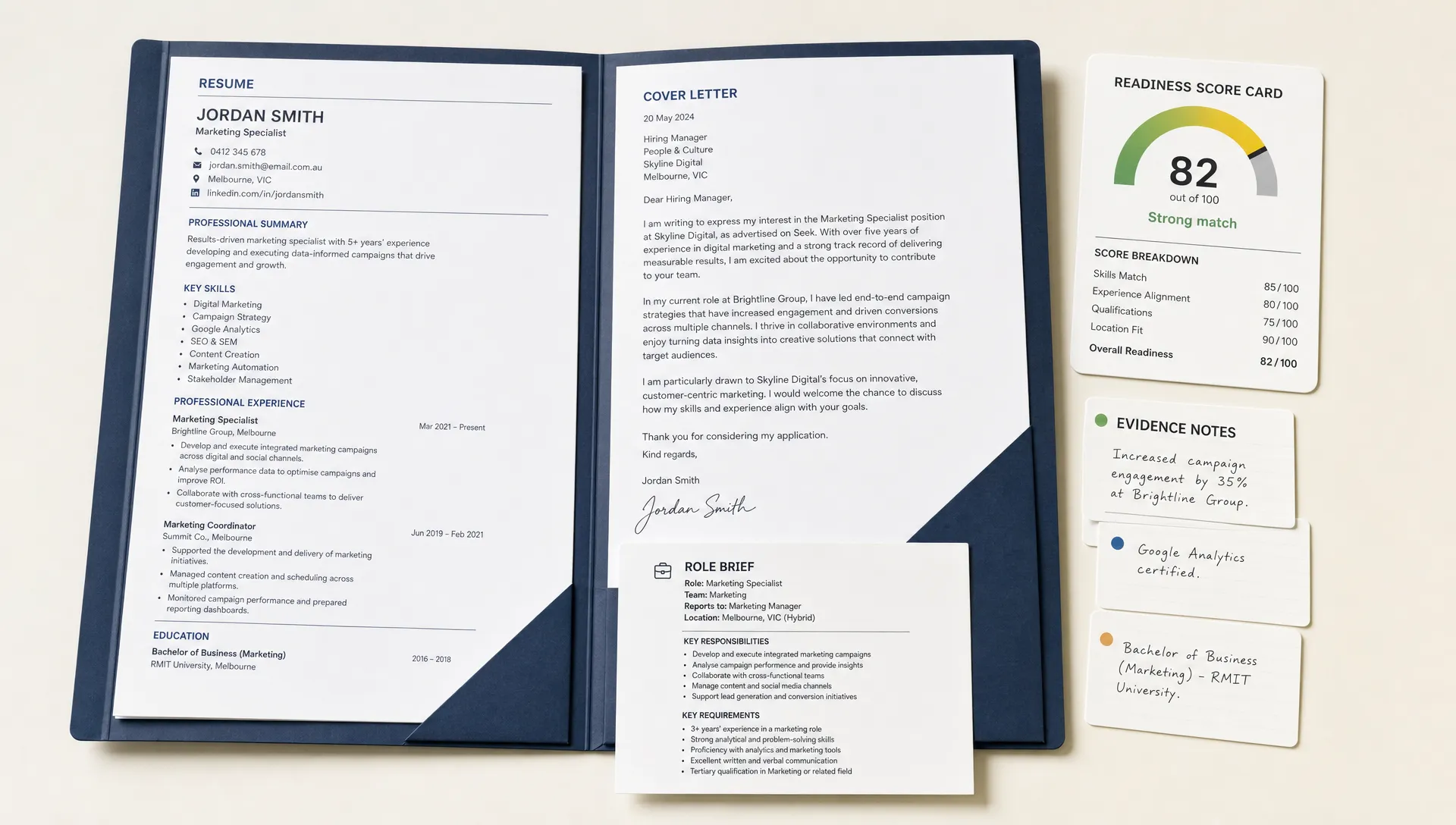
Employers rarely read applications for a job like a life story. They read them like a decision document. They are trying to work out whether you understand the role, meet the core requirements and can back up your claims with enough evidence to deserve an interview.
That can feel blunt, especially if you are a student, recent graduate or career changer with a less traditional background. The good news is that employers do not expect perfection. They expect relevance, care and a clear connection between what they need and what you can offer.
In 2026, strong applications need to do more than look tidy. They need to pass initial screening, speak to the job ad, answer the employer's doubts and make the next step feel low-risk for the hiring team.
Every role exists because an organisation has a problem to solve. A café needs reliable staff who can handle pressure. A graduate program needs people who can learn fast, communicate clearly and work in a team. A project coordinator role needs someone who can keep moving parts under control without constant supervision.
Your application should make that connection obvious. Employers are usually assessing four things at once: capability, motivation, reliability and fit. Capability is whether you can do the work. Motivation is whether you genuinely want this type of role. Reliability is whether you follow instructions, communicate professionally and show attention to detail. Fit is whether your experience, values and working style make sense for the team.
That is why generic applications underperform. A resume that lists everything you have ever done makes the employer do the work of finding the match. A stronger application filters your background through the role in front of you.
Before an employer judges your achievements, they notice whether you followed the application instructions. If the ad asks for a cover letter, include one. If it asks you to answer selection criteria, answer them directly. If it requests a PDF, do not send a Pages file or an image-based document.
These details seem small, but they signal how you may behave at work. A missed document, vague subject line or poorly named file can suggest that you skim instructions, especially in roles where accuracy matters.
At minimum, employers expect your application to include:
If you are applying through a portal, complete every required field with care. Do not rely on see attached resume if the form asks for a direct answer. Many hiring teams use those fields to screen quickly, so incomplete answers can weaken an otherwise solid application.
A tailored resume does not mean rewriting your entire history from scratch each time. It means choosing the most relevant evidence and arranging it so the employer sees the match quickly.
Start by reading the job ad as a checklist. Look for repeated skills, responsibilities, tools, qualifications and personal attributes. Then ask which parts of your background prove those points. If you need a more detailed process, Versadox has a practical guide on matching your resume to the job you want.
Employers expect your resume to show the most relevant information early. For experienced applicants, that usually means a sharp summary, key skills and recent role achievements. For students or graduates, it may mean education, placements, projects, internships, casual work and volunteer experience. For career changers, transferable skills should be translated into the language of the target role rather than left buried in unrelated job titles.
For example, a retail supervisor moving into customer success should not only list retail tasks. They should highlight customer problem-solving, complaint handling, team coordination, reporting, product knowledge and service recovery. The employer needs to see how the old context maps to the new one.
Many applications rely on claims such as hard-working, passionate, organised or strong communicator. Those words are not wrong, but they are weak without proof. Employers expect you to show how those qualities appeared in real situations.
A stronger application turns vague claims into evidence:
You do not need huge achievements. Entry-level applicants often underestimate everyday proof. Turning up consistently, handling busy shifts, completing placements, supporting customers, improving a process or learning software quickly can all matter when framed against the role.
Numbers help when they are honest and relevant. If you served 80 customers a day, reduced errors, met sales targets, supported a team of six or completed a project two weeks early, include that detail. If you do not have numbers, use context: busy environment, strict deadlines, confidential information, vulnerable clients, safety procedures or complex stakeholder needs.
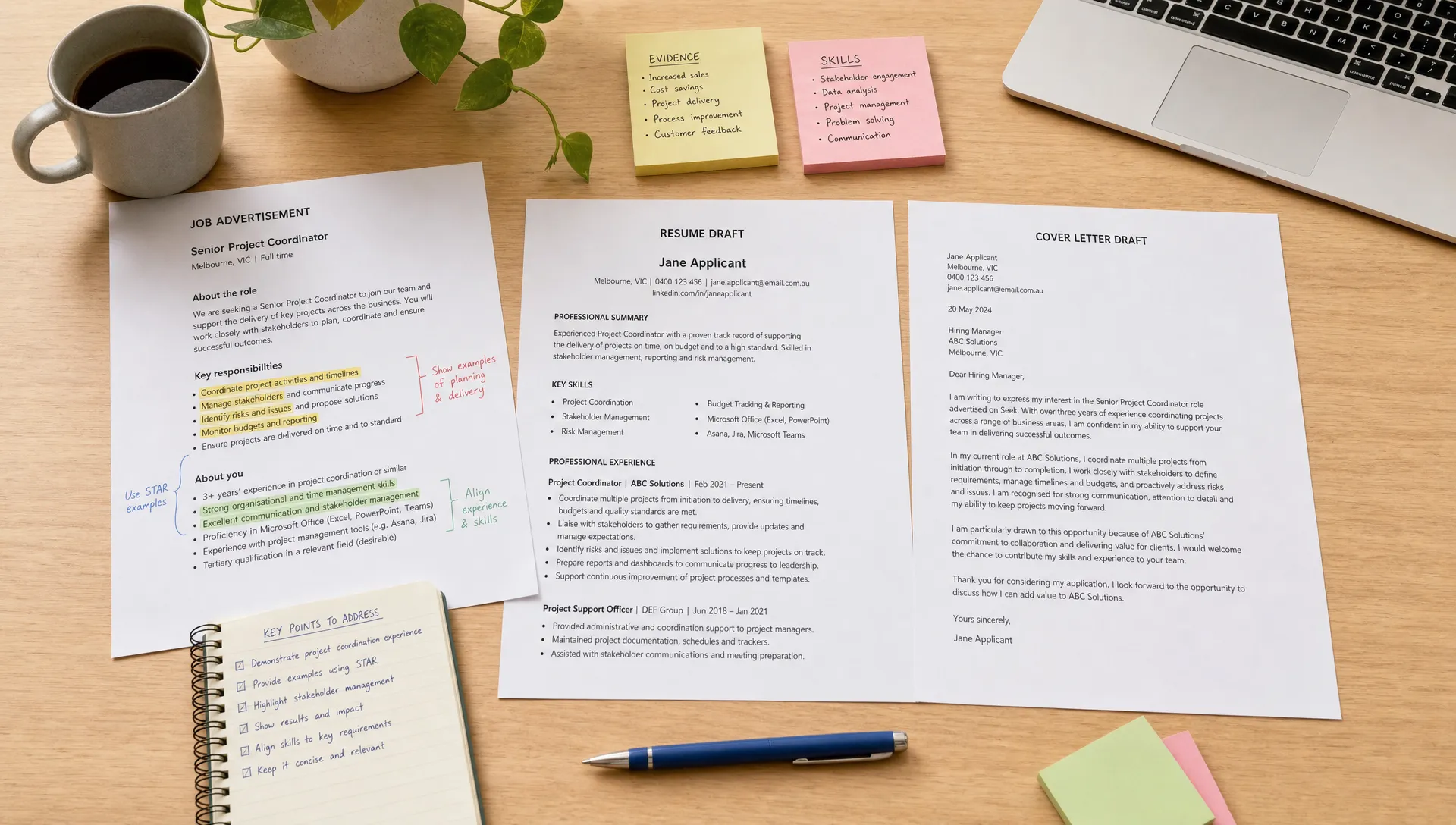
Employers do not always read cover letters first, but when they do, they are looking for focus. A good cover letter is not a repeat of your resume. It explains why you are applying, why your background fits and what evidence supports that fit.
The best cover letters usually make three points clearly. First, they name the role and show you understand what it involves. Second, they connect two or three of your strongest examples to the employer's needs. Third, they close professionally without sounding desperate or generic.
This is especially useful if your resume needs context. Career changers can explain the logic behind the move. Graduates can connect coursework, placements and part-time work to the role. Applicants with a gap can briefly refocus the reader on current readiness and relevant strengths.
If you are unsure how specific to be, use the job ad as your guide. Versadox covers this in more depth in what to write in a cover letter for real impact, including how to keep the letter relevant rather than padded.
A strong application shows that you understand the environment you are applying into. That does not mean pretending to be an insider. It means noticing what matters in that field and choosing evidence that matches.
For a hospitality role, availability, pace, customer service and reliability may matter most. For health or community roles, compliance, empathy, documentation and safeguarding may be critical. For government applications in Australia, selection criteria and structured examples often carry significant weight. For technical or operational roles, employers may look for systems knowledge, safety awareness and evidence that you can follow regulated processes.
Specialist industries are a good example. If you were applying for a drone operations, surveying or aerial data role, it would be more useful to discuss flight planning, risk assessments, checklists and compliance workflows than to make a broad claim about being tech-savvy. Familiarity with drone operations management and flight planning platforms such as Dronedesk may be relevant if the job ad mentions operational planning, flight logging or safety documentation.
The point is not to name-drop tools for the sake of it. Employers expect your application to reflect the real work behind the job title.
Many employers use applicant tracking systems to collect and sort applications. These systems do not replace human judgement, but they can affect whether your information is easy to read, search and compare.
ATS-ready formatting is usually simple formatting. Use clear headings such as Experience, Education, Skills and Certifications. Avoid placing critical information only in images, icons, graphics or complex columns. Use standard file types unless the employer asks for something different.
Professional presentation also includes consistency. Dates should line up. Job titles should be clear. Spelling should be checked. Your phone number and email should be easy to find. If the role asks for attention to detail, your application is the first sample of that skill.
Do not confuse design with quality. A visually impressive resume can still fail if it hides the evidence. A plain, well-structured resume that clearly matches the role is often more effective than a decorative one that makes the employer hunt for substance.
For many roles, employers will look beyond the documents you submit. They may check LinkedIn, a portfolio, GitHub, a personal website or other professional profiles if you provide them. They may also notice whether your LinkedIn dates, job titles and qualifications match your resume.
You do not need to be active on every platform. You do need consistency. If your resume says you are seeking marketing roles but your profile headline points to an unrelated field, update it. If your portfolio link is broken, remove it or fix it. If your voicemail is unprofessional or your inbox is full, sort that out before applying.
For students and graduates, a simple LinkedIn profile with education, projects, work experience and a clear headline can support your application. For career changers, your profile can help explain your direction by showing the bridge between past experience and future roles.
Many applicants weaken their applications because they try to sound like the perfect candidate. Employers usually know that no one meets every ideal requirement, especially for entry-level, graduate and transition roles.
They do not expect:
It is better to be specific and credible than polished but vague. If you are missing a skill, show how you are closing the gap. If you have limited experience, show relevant projects, coursework, volunteering, casual work or transferable achievements. If you are changing careers, explain the connection rather than hoping the employer guesses it.
Some issues do not automatically disqualify you, but they add friction. If the employer has many strong applicants, friction matters.
Common red flags include a resume that is clearly mass-sent, a cover letter addressed to the wrong company, unexplained contradictions, missing contact details, spelling errors in key sections and claims that sound too broad to trust. Another common issue is applying for roles that are far outside your evidence without explaining the bridge.
There is also a difference between confidence and overclaiming. If you call yourself an expert after completing one short course, an employer may question your judgement. If you describe yourself as developing skills in that area and support it with a project, the claim is easier to believe.
Before sending applications for a job, pause for five minutes and assess them like a recruiter. You are not asking whether the application is impressive in general. You are asking whether it is convincing for this role.
Use this checklist before you apply:
If the answer is no to several of these, improve the application before sending it. More applications are not always better. Better aligned applications usually give you a stronger chance of getting noticed.
Do employers read every part of applications for a job? Not always in the same order. Some start with the resume, some scan screening questions and some use cover letters to decide between similar candidates. Your whole application should be consistent because any part may influence the shortlist decision.
Should I apply if I do not meet every requirement? Yes, if you meet the core requirements and can show relevant evidence. Many job ads include ideal criteria. Focus on proving the most important skills and explain how you are building any missing capability.
How long should my resume be? For students and graduates, one to two pages is usually enough. More experienced applicants may need two to three pages, depending on the role. The key is relevance, not length.
Is a cover letter still worth writing? If the employer asks for one, it matters. If it is optional, a focused cover letter can still help when you need to explain motivation, a career change or a strong fit that is not obvious from your resume alone.
Employers expect applications that are clear, relevant and backed by evidence. You do not need to guess whether your resume and cover letter are strong enough for a role.
Versadox helps job seekers compare their resume against real roles, identify gaps and see how it scores before applying. If you want to know where you stand before you submit, use the application process as a strategy, not a guessing game.
This is a div block with a Webflow interaction that will be triggered when the heading is in the view.
Drop your resume in and get a real score in under a minute — plus the single biggest thing holding it back. No account needed.
Get my free score


