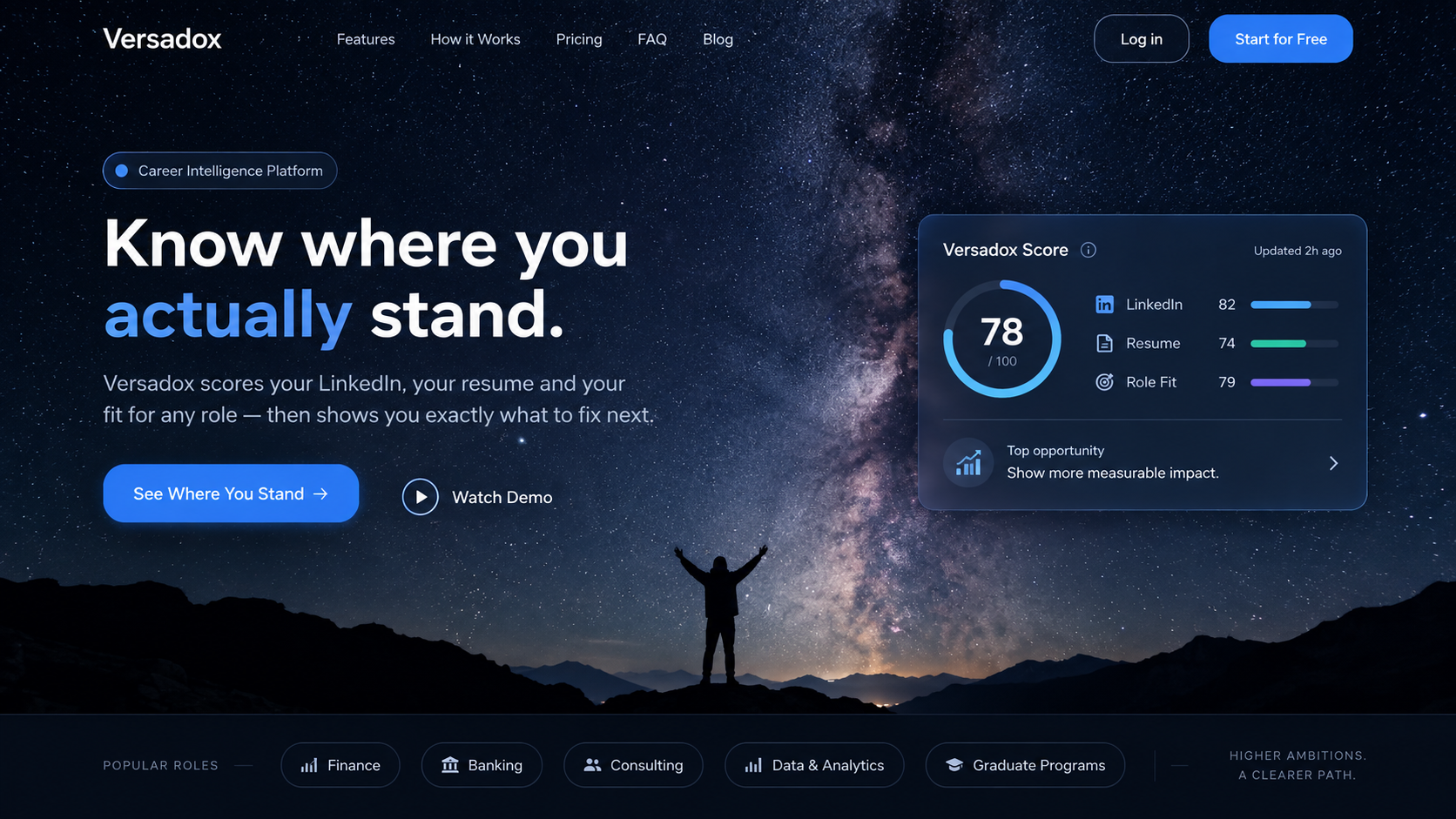
Most job search advice treats your resume, your professional profile and the jobs you are applying for as three separate problems. Fix the resume. Then fix the LinkedIn. Then figure out which jobs to apply to. Each one gets worked on alone, and none of them tells you whether the other two are pulling in the same direction.
Versadox was built around a different idea: your resume, your profile and the role you are targeting are one problem, not three. Read together, they produce a single number — your Career Health score — and a clear, fixable reason behind every point of it.
Why one score instead of three
If you have ever paid someone to review your resume and a different person to review your LinkedIn, you already know the failure mode. The resume reviewer tells you to lead with your project management experience. The profile reviewer tells you to lead with your technical skills. Neither one has seen the other document, and neither has seen the actual job ad you are chasing.
The result is three well-intentioned pieces of advice that quietly contradict each other, because no single reviewer is holding your whole picture at once.
A composite score fixes that by design. Career Health is not an average of three unrelated checks — it is one model reading your resume, your profile and your target role together, so the advice it gives you is advice that holds up across all three at the same time.
Versadox builds your score from three sources:
- Your resume — what you have done, how it is written, and whether it would survive contact with an applicant tracking system before a human ever sees it
- Your professional profile — your LinkedIn or SEEK profile, which is often the first (and sometimes only) thing a recruiter actually opens
- The role you are targeting — the specific job ad you are comparing yourself against, not a generic industry benchmark
Most tools only look at one of these. A resume grammar checker only reads the resume. A LinkedIn headline generator only reads the profile. Versadox reads all three, which is the only way to answer the question job seekers actually have: not "is my resume good," but "am I a strong candidate for this role, right now, based on everything an employer could see about me?"
What actually makes up the score
Career Health is scored out of 100, broken into parts you can see and act on individually rather than one opaque number:
- Skills — whether the skills you list are actually evidenced (not just mentioned), and whether they match what the market is currently asking for in your target role
- Experience — whether your work history reads as relevant to where you are trying to go, including title alignment, progression and quantified impact
- Application Readiness — the mechanical stuff: does your resume parse cleanly through the systems screening it, does it use the keywords the ad actually asks for, is your SEEK or LinkedIn profile complete
- Social Capital — how discoverable and credible your profile is to the people who might actually reach out to you before you even apply
Here is the part most people do not expect: a perfect resume cannot get you a perfect score. Skills, Experience and Application Readiness all come from your resume, and even nailing every one of them caps out short of 100. The remaining points live in Social Capital — the part of your profile that has nothing to do with how well-written your resume is. That is deliberate. No document, however polished, makes you findable. Being found is a separate skill, and Versadox scores it as one.
Where the job you are targeting fits in
Your Career Health score tells you how strong a candidate you are in general. Job Comparison answers a narrower, more useful question: how well do you match this specific role, right now?
Paste in a job you are considering and Versadox lines your resume up against it — skills required versus skills evidenced, experience level versus what the ad expects, industry fit, and whether your achievements actually transfer to what this employer is asking for. You get back a breakdown of what already matches and, just as importantly, what does not. If you want to see how this plays out in practice, the Versadox guide on matching your resume to the job you want walks through it in more detail.
This is the piece that turns a general score into a decision. A 78 on your overall Career Health does not tell you whether to apply for a specific senior analyst role closing on Friday. A Job Comparison run against that exact ad does.

Why the score itself is free
Versadox's position is simple: knowing where you stand should never sit behind a paywall. Your Career Health score, all four subscores, and one full check of your resume, profile and a job comparison are free, no matter what. What you pay for, if you choose to, is going deeper — unlimited re-scoring as you make changes, full gap-by-gap fix instructions, and comparing yourself against more roles.
That line is intentional. A score you cannot trust because it is trying to sell you something is not worth having. A score that is honest about where you are weak, even in the free tier, is the only kind that actually helps you decide what to fix first.
What to actually do with the number
A score on its own is trivia. What makes Career Health useful is that every point is attached to a named, fixable reason — not "improve your resume," but "the ad asks for SQL, Power BI and stakeholder reporting; you currently evidence one of the three." That is the difference between a grade and a plan.
The practical order most people should work through is:
- Run the audit first so you know your actual starting point, not your assumed one
- Fix the highest-delta issue in your lowest pillar rather than polishing the pillar that is already strong
- Run a Job Comparison against the specific role you want before you apply, not after you get silence back
- Re-check after you make changes so you can see the number move, not just hope it did
Frequently Asked Questions
Does Versadox write my resume or cover letter for me? No. Versadox audits and scores the resume and profile you already have, and compares them against the roles you are targeting. It shows you exactly what to fix and why — the writing and the decisions stay yours.
Is the Career Health score free? Yes. The full score, all four subscores and one complete check across your resume, profile and a job comparison are free. Paid plans add unlimited re-scoring and deeper, ongoing gap analysis.
Can I get a perfect score just by fixing my resume? No, and that is by design. Three of the four pillars come from your resume, but the fourth — Social Capital — comes from your profile's discoverability and credibility. A great resume nobody can find still leaves points on the table.
How is this different from a generic resume checker? A generic checker only reads your resume in isolation. Versadox reads your resume, your profile and the specific role you are chasing together, so the advice reflects your whole candidacy, not one document out of context.
One number, a clear next step
You do not need three separate opinions on three separate documents. You need one honest read of where you actually stand, and a specific reason behind every point of it. That is what Career Health is for — a single score built from your resume, your profile and the role in front of you, so your next move is obvious instead of guessed at.
If you have not run your score yet, it takes a few minutes and it is free. See exactly where you stand, then decide what is worth fixing first.